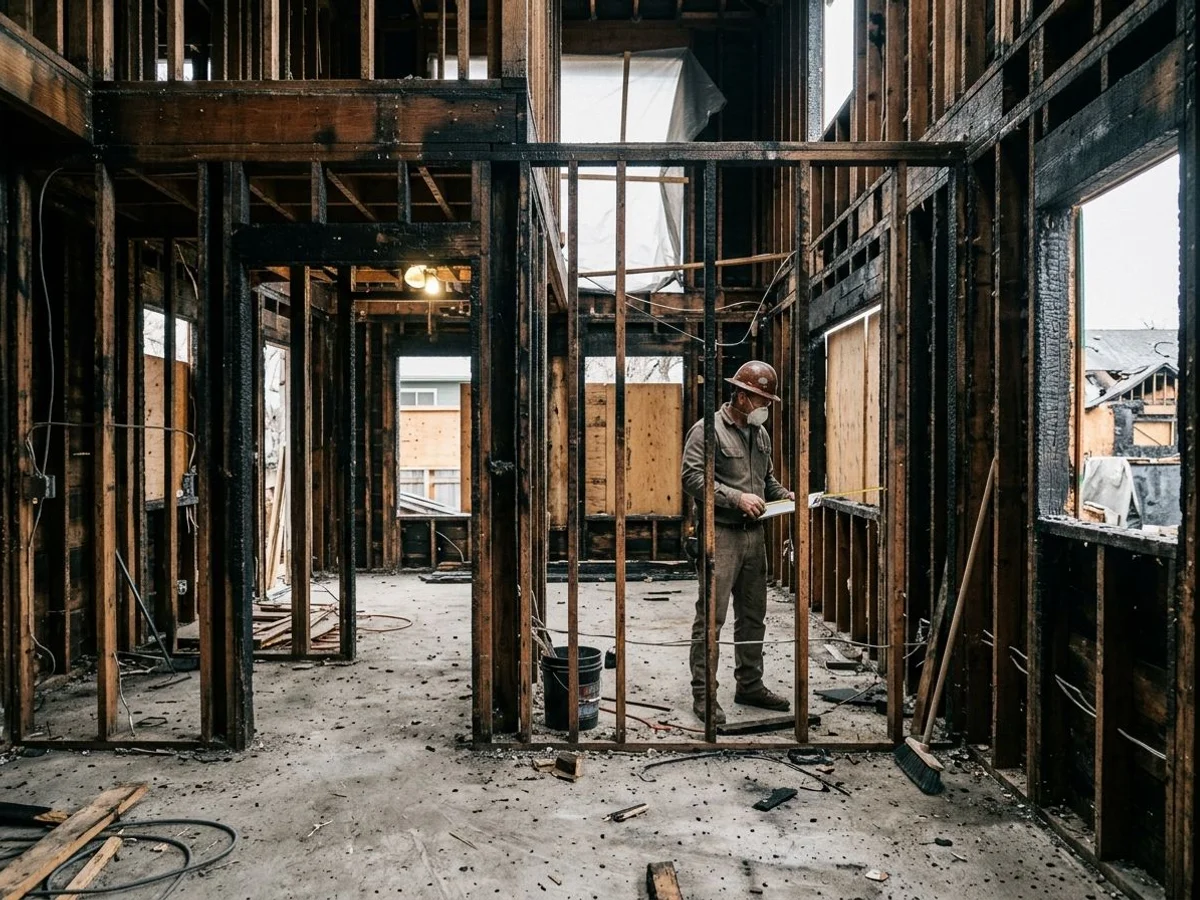
What fire-damage asbestos abatement actually involves
A house fire does not stay contained to what you can see burn. Firefighters knock holes in walls chasing hidden flame. Crews tear out scorched drywall, insulation, and flooring during cleanup.
Many Boulder homes built before the 1980s still have asbestos in old pipe wrap, floor tile, textured ceilings, or duct insulation. The Consumer Product Safety Commission notes older homes commonly used asbestos this way, especially for basement pipe insulation. Fire and demolition work can crack or crumble that material fast.
For over 20 years, our crews have handled fire damage across the Front Range, and our lead technicians hold IICRC FSRT and EPA Lead-Safe certification. So before any tear-out starts on an older home, we treat asbestos testing as a normal part of the job, not an afterthought.
What Boulder homes need before fire and smoke repairs begin
Not every case involves open flame. After the Marshall Fire, we worked in homes where the damage was pure smoke intrusion through the HVAC system. No flame ever touched the house, but smoke odor ran deep into the drywall and ductwork.
To chase that smoke out, crews open ceiling cavities and pull duct sections apart. What homeowners do not realize is that old duct wrap or pipe insulation can hide asbestos even when the fire itself never reached that room.
And that is why we test first, then plan the tear-out. Skipping that step on an older Boulder or Front Range home can turn a smoke cleanup into an air-quality problem.
Why DIY and generalist contractors miss this step
Federal rules under the Asbestos NESHAP mostly target schools, commercial buildings, and larger apartment properties.[1] A lot of contractors read that and assume a single-family home has nothing to check.
Colorado does not work that way. The state requires a certified asbestos building inspector before renovation or demolition work disturbs material past a set amount, on a home of any age.
For a single-family house, that trigger is 50 linear feet of pipe insulation, 32 square feet on other surfaces, or a volume equal to a 55-gallon drum. Go over that, and a Colorado-certified General Abatement Contractor has to handle the removal, with a permit and a 10-business-day notice to the state, unless an emergency waiver applies.
A generalist crew that skips testing because it is just a house can walk you straight into a state violation, on top of a health risk.
What happens to fire and smoke restoration during abatement
Abatement clears the air of asbestos. It does not deodorize smoke, and it does not rebuild anything. Those are separate jobs, and we run them back to back so you are not juggling different vendors mid-project.
Once the abatement crew gets clearance test results back, our fire and smoke technicians move in to finish soot cleaning, deodorizing, and drywall repair.
Our 100% Smoke Odor Guarantee covers that half of the job. If smoke odor returns within 30 days of completion, we come back and re-treat the property at no charge.
Asbestos abatement coverage across Boulder County
We handle fire-damage asbestos testing and abatement coordination across Boulder, Longmont, Lafayette, Louisville, Erie, Superior, and Broomfield.
So wherever your fire-damaged home sits in that service area, we can get a certified inspector out fast and keep your reconstruction and insurance claim moving at the same time.
Reference:
[1] U.S. EPA, Information for Owners and Managers of Buildings that Contain Asbestos: epa.gov/asbestos